Showing posts with label About the Prophet Muhammad. Show all posts

Sunday, March 15, 2015

The Scientific Miracles of the Prophet Muhammad Sayings: The Seven Earths


The seven layers of the earth which scientists have recently discovered was eluded to by Prophet Muhammad 1400 years ago.
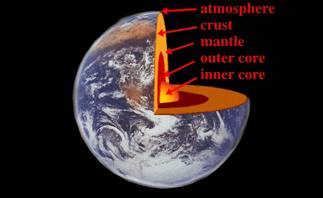

A simple image of Earth and the interior layers.  Windows to the Universe, at (http://www.windows.ucar.edu) at the University Corporation for Atmospheric Research (UCAR).  ©1995-1999, 2000 The Regents of the University of Michigan; ©2000-05 University Corporation for Atmospheric Research.
The Sunnah of Prophet Muhammad is the second revealed source of Islam.  Like the Quran, it contains scientific information unavailable 1400 years ago.  From these miracles is the "seven" earths, mentioned by the Prophet in several of his sayings.  From them are the following two:

Hadith 1

It was narrated on the authority of Abu Salamah that a dispute arose between him and some other people (about a piece of land).  When he told Aisha (the Prophet’s wife) about it, she said, ‘O Abu Salamah!  Avoid taking the land unjustly, for the Prophet said:
"Whoever usurps even one span of land of somebody, its depth through the seven earths will be collared to his neck." (Saheeh Al-Bukhari, ‘Book of Oppression.’)

Hadith 2

Salim narrated on the authority of his father that the Prophet said:
"Whoever takes a piece of land of others unjustly, he will sink down the seven earths on the Day of Resurrection." (Saheeh Al-Bukhari, ‘Book of Oppression.’)
The aforementioned hadith prohibits oppression in general, especially the taking of a piece of land belonging to others unjustly.  What might the seven earths refer to?
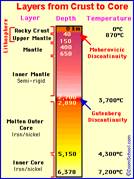
Studies in geology have proven that the earth is composed of seven zones, identified from the inner to the outer layers as follows:
(1)  The Solid Inner Core of Earth: 1.7% of the Earth’s mass; depth of 5,150 - 6,370 kilometers (3,219 - 3,981 miles)
The inner core is solid and unattached to the mantle, suspended in the molten outer core.  It is believed to have solidified as a result of pressure-freezing which occurs to most liquids when temperature decreases or pressure increases.
(2)  The Liquid Outer core: 30.8% of Earth’s mass; depth of 2,890 - 5,150 kilometers (1,806 - 3,219 miles)
The outer core is a hot, electrically conducting liquid within which convective motion occurs.  This conductive layer combines with Earth’s rotation to create a dynamo effect that maintains a system of electrical currents known as the Earth’s magnetic field.  It is also responsible for the subtle jerking of Earth’s rotation.  This layer is not as dense as pure molten iron, which indicates the presence of lighter elements.  Scientists suspect that about 10% of the layer is composed of sulfur and/or oxygen because these elements are abundant in the cosmos and dissolve readily in molten iron.
(3)  The "D" Layer: 3% of Earth’s mass; depth of 2,700 - 2,890 kilometers (1,688 - 1,806 miles)
This layer is 200 to 300 kilometers (125 to 188 miles) thick and represents about 4% of the mantle-crust mass.  Although it is often identified as part of the lower mantle, seismic discontinuities suggest the "D" layer might differ chemically from the lower mantle lying above it.  Scientists theorize that the material either dissolved in the core, or was able to sink through the mantle but not into the core because of its density.
(4)  Lower Mantle: 49.2% of Earth’s mass; depth of 650 - 2,890 kilometers (406 -1,806 miles)
The lower mantle contains 72.9% of the mantle-crust mass and is probably composed mainly of silicon, magnesium, and oxygen.  It probably also contains some iron, calcium, and aluminum.  Scientists make these deductions by assuming the Earth has a similar abundance and proportion of cosmic elements as found in the Sun and primitive meteorites.
(5)  Middle Mantle (Transition region): 7.5% of Earth’s mass; depth of 400 - 650 kilometers (250-406 miles)
The transition region or mesosphere (for middle mantle), sometimes called the fertile layer, contains 11.1% of the mantle-crust mass and is the source of basaltic magmas.  It also contains calcium, aluminum, and garnet, which is a complex aluminum-bearing silicate mineral.  This layer is dense when cold because of the garnet.  It is buoyant when hot because these minerals melt easily to form basalt which can then rise through the upper layers as magma.
(6)  Upper Mantle: 10.3% of Earth’s mass; depth of 10 - 400 kilometers (6 - 250 miles)
The upper mantle contains 15.3% of the mantle-crust mass.  Fragments have been excavated for our observation by eroded mountain belts and volcanic eruptions.  Olivine (Mg,Fe)2SiO4 and pyroxene (Mg,Fe)SiO3 have been the primary minerals found in this way.  These and other minerals are refractory and crystalline at high temperatures; therefore, most settle out of rising magma, either forming new material or never leaving the mantle.  Part of the upper mantle called the asthenosphere might be partially molten.
(7)  Lithosphere
Oceanic crust: 0.099% of Earth’s mass; depth of 0-10 kilometers (0 - 6 miles)
The rigid, outermost layer of the Earth comprising the crust and upper mantle is called the lithosphere.  The oceanic crust contains 0.147% of the mantle-crust mass.  The majority of the Earth’s crust was made through volcanic activity.  The oceanic ridge system, a 40,000-kilometer (25,000 mile) network of volcanoes, generates new oceanic crust at the rate of 17 km3 per year, covering the ocean floor with basalt.  Hawaii and Iceland are two examples of the accumulation of basalt piles.
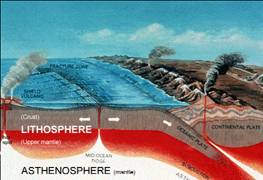
This image shows a cross section through the earth’s crust and upper mantle showing lithosphere plates (made of the crust layer and the top part of the mantle) moving over the asthenosphere (upper mantle).  Windows to the Universe, at (http://www.windows.ucar.edu) at the University Corporation for Atmospheric Research (UCAR).  ©1995-1999, 2000 The Regents of the University of Michigan; ©2000-05 University Corporation for Atmospheric Research.  Continental crust: 0.374% of Earth’s mass; depth of 0-50 kilometers (0 - 31 miles)
The continental crust contains 0.554% of the mantle-crust mass.  This is the outer part of the Earth composed essentially of crystalline rocks.  These are low-density buoyant minerals dominated mostly by quartz (SiO2) and feldspars (metal-poor silicates).  The crust (both oceanic and continental) is the surface of the Earth; as such, it is the coldest part of our planet.  Because cold rocks deform slowly, we refer to this rigid outer shell as the lithosphere (the rocky or strong layer).
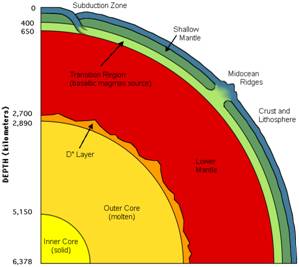
This image shows the divisions of the Earth’s interior into 7 layers.  (Adapted from Beatty, 1990).

Conclusion

The layers of the earth coincide with the above mentioned hadith of the Prophet.  The miracle is in two matters:
(1)  The expression of the hadith, ‘He will sink down the seven earths on the Day of Resurrection,’ indicates the stratification of these "earths" around one center.
(2)  The accuracy with which the Prophet of Islam referred to the seven inner layers of earth.
The only way for a desert dweller to have known these facts 1400 years ago is through revelation from God.
References

Beatty, J. K. and A. Chaikin, eds.  The New Solar System.  Massachusetts: Sky Publishing, 3rd Edition, 1990.
Press, Frank and Raymond Siever.  Earth.  New York: W. H. Freeman and Company, 1986.
Seeds, Michael A. Horizons. Belmont, California: Wadsworth, 1995.
El-Najjar, Zaghloul.  Treasures In The Sunnah: A Scientific Approach: Cairo, Al-Falah Foundation, 2004.

Monday, March 9, 2015

PROPHET MUHAMMAD ﷺ- THE WORLD'S BEST TEACHER


Some of the most influential people in our lives are teachers. Most of us can remember our very first teacher in school, the one who taught us our ABC's and the proper rules of the playground. As we have progressed from toddler to adult, there have been countless teachers along the way who helped us on our journey to adulthood and even beyond. The high school math teacher who helped you to perfect your Algebra or the college professor that taught you the spirit of debate, the very fabric of our being is heavily influenced by teachers who guided us in our educational journeys.

In Islam, there is only one teacher who has laid out the groundwork for the spiritual education of mankind, by the Grace of Allah, the Almighty. The Prophet Muhammad (peace be upon him), an illiterate man, was chosen by Allah, the Almighty to be the Final Messenger and perfect teacher to Muslims and as well as Non-Muslims.

No Student Left Behind

In classrooms all over the world, it is a common practice for teachers to separate the strong students from the weak. The latter of which are delegated to less challenging classes that do nothing to nurture the mind while the "smarter" students are given every opportunity to excel.

Prophet Muhammad made no distinction between students based on intelligence level, social standing or any other classification that separates us in society. He also never sought to exclude or expel anyone from the religion of Islam, but rather delivered a message that was all-inclusive to the whole of mankind. The Prophet Muhammad said: "By Allah! If He may guide through you a single man to Islam, it would be better for you than red camels." (Al-Bukhari, 192)

By setting this example of inclusion, Muslims have a tangible example of how to attract others to the Islamic faith.

The Perfect Speaker

Most of us, at some point or another, have come across at least one teacher that was inaudible or spoke so fast that it was next to impossible to understand what was being said let alone taught. Even today, the rapid pace in which most educators speak is overlooked so as to cram as much information into each lesson as possible.

Prophet Muhammad was methodical in his teaching methods and never rushed his lessons. According to his beloved wife Aisha, he: "...spoke in such a way that if one were to count his words, they could be counted." (Al-Bukhari,768)

The Prophet also, according to his companions, would repeat his words thrice. The words that he spoke and the lessons he delivered were unambiguous, which helped students of Islam excel at perfecting their faith and committing the Quran to their hearts. The perfection of Prophet Muhammad's speech was intentional as a means to really drive the message home to each one of his students through repetition, which is an excellent learning tool.

Living by Example

Perhaps one of the greatest qualities that made Prophet Muhammad such a phenomenal teacher is that he led by example. He often lectured to his companions about the Oneness of God Almighty, living a life in accordance with Islam and being mindful of the Hereafter.

In every aspect of his life, Prophet Muhammad was an exemplar and practiced what he preached. This made it easy for his companions to see, up close and personal, how to live their lives in accordance with the Quran and Sunnah. As Allah, the Almighty says in the Quran: There has certainly been for you in the Messenger of Allah an excellent pattern for anyone whose hope is in Allah and the Last Day and [who] remembers Allah often. Qur’an Surah Ahzab 33:21

If Prophet Muhammad had not lived every aspect of the Quran in minute detail, it would have had a derogatory effect on the level of trust that he had developed with his companions.

Patience Through Adversity

For many teachers, there is a very fine line between reaching out to students in the spirit of understanding and not being able to get through to the students who fight every step of the way.

The Prophet Muhammad was met with an enormous amount of disdain and outright hatred as he began teaching the message of Islam at the onset of his Prophethood. In Makkah, he spent thirteen years  in an attempt to teach people about the message of the Quran and was met with violent resistance every step of the way with only a minority of his people embracing Islam.

Prophet Muhammad met similar, albeit less, conflict after settling in Madinah and not once did he even consider quitting. Some of the finest personal attributes that helped to strengthen his resolve and reinforce his dedication to his mission included wisdom, patience and a willingness to make sacrifices for the sake of Allah Almighty.

Conclusion

In every aspect of his life, Prophet Muhammad was an exemplar and practiced what he preached. The method in which Prophet Muhammad taught the message of Islam to his companions had a ripple effect that has transcended centuries to make Islam the world's fastest growing religion today. Whether you are a new Muslim or a born-Muslim, the example of Prophet Muhammad as a gifted teacher is a unifying force in the Islamic world and continues to be a means for greater understanding through education.

References

www.Onislam.net

Monday, February 16, 2015

Who Is the Prophet Muhammad ?


Who Is the Prophet Muhammad ?

Muhammad  was born in Makkah in the year 570.  Since his father died before his birth and his mother died shortly thereafter, he was raised by his uncle who was from the respected tribe of Quraysh.  He was raised illiterate, unable to read or write, and remained so till his death.  His people, before his mission as a prophet, were ignorant of science and most of them were illiterate.  As he grew up, he became known to be truthful, honest, trustworthy, generous, and sincere.  He was so trustworthy that they called him the Trustworthy.1  Muhammad  was very religious, and he had long detested the decadence and idolatry of his society.
 
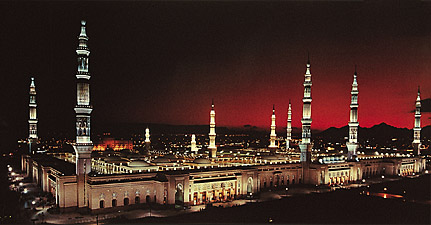
The Prophet Muhammad’s Mosque in Madinah
The Prophet Muhammad’s  Mosque in Madinah.
At the age of forty, Muhammad  received his first revelation from God through the Angel Gabriel.  The revelations continued for twenty-three years, and they are collectively known as the Quran.
As soon as he began to recite the Quran and to preach the truth which God had revealed to him, he and his small group of followers suffered persecution from unbelievers.  The persecution grew so fierce that in the year 622 God gave them the command to emigrate.  This emigration from Makkah to the city of Madinah, some 260 miles to the north, marks the beginning of the Muslim calendar.
After several years, Muhammad  and his followers were able to return to Makkah, where they forgave their enemies.  Before Muhammad  died, at the age of sixty-three, the greater part of the Arabian Peninsula had become Muslim, and within a century of his death, Islam had spread to Spain in the West and as far East as China.  Among the reasons for the rapid and peaceful spread of Islam was the truth and clarity of its doctrine.  Islam calls for faith in only one God, Who is the only one worthy of worship.
The Prophet Muhammad  was a perfect example of an honest, just, merciful, compassionate, truthful, and brave human being.  Though he was a man, he was far removed from all evil characteristics and strove solely for the sake of God and His reward in the Hereafter.  Moreover, in all his actions and dealings, he was ever mindful and fearful of God.

Contact us

 
Search Engine Submission - AddMe